Monday, February 13, 2012

Schenck vs. United States

In class I have started to research the court case Schenck vs. United States. This was a very important case in American history for several reasons. The Supreme Court passed the Espionage Act of 1917 which stated that one did not have the right to their first amendment right to free speech against the newly implemented draft. When I first heard the terms of the Espionage Act of 1917 I was shocked to see that law was actually passed. I found it to be completely unconstitutional!!!!!!!

Charles Schenck was the Secretary of the Socialist Party (I found it interesting to learn that the US actually had a socialist party at one point) and was in charge of sending potential draftees pamphlets. These pamphlets were actually not pro-draft pamphlets. I found out that they were actually encouraging draftees to stand up against the draft. In these pamphlets he was saying things like "In lending tacit or silent consent to the conscription law, in neglecting to assert your rights, you are (whether knowingly or not) helping to condone and support a most infamous and insidious conspiracy to abridge and destroy the sacred and cherished rights of a free people." The comments in the pamphlets was what got Schenck in trouble with the Supreme Court. 

This was an extremely public and much talked about case. It was very difficult trying to find a newspaper article on the subject but the New York Times had an article about the case on March 4, 1919. This article was basically just keeping the public informed about what was going on in the case and who was being charged with what. No one could just look on their iPhone and see how the case was going back then so this was the way the public got to hear about the national news of the time.

propaganda poster

I found an excellent book on AVL called Great American Trials In Schenck's indictment he was no evidence was there to prove that he had "corrupted" any single soldier. However the court thought that the publication of the pamphlets its self was enough to say he was guilty. Schenck's defense simply argued that this was completely against the First Amendment. However, he was found guilty so he appealed the court's decision. Justice Oliver Holmes said that if it had been peace time when this case had been brought up he would have been innocent but since it was war time he was found guilty. I thought that was the most ridiculous thing ever! I just could not believe that you could change a law to be different war time and peace. 

The most important thing I found about this case was the "clear and present danger". During the trial Justice Holmes said "The question in every case is whether the words used are used in such circumstances and are of such a nature as to create a clear and present danger that they will bring about the substantive evils that Congress has a right to prevent." Basically this means that if what Schenck was trying to tell people was seriously detrimental to the United States, Congress had the right to punish him for what he was saying. So the court had to judge whether or not something was a "clear and present danger" to the war efforts of the time. 

In my research I found that this was an incredibly unconstitutional trial. Schenck should have never been sentenced to six months in prison for what he did. It is completely within his rights of the First Amendment as a US citizen. I sincerely hope that nothing like this ever happens again in our courts of law. I think this all happened because Americans were scared about going into such a massive war and they were just trying to protect the nation that they so dearly loved. 
Chief Justices at the time
 

Monday, January 30, 2012

WWI poetry

I decided to read "Dead Cow Farm" by Robert Graves. I picked this poem in particular because I thought it was just a very interesting and unusual name for a poem. In the poem it describes a cow as the creator of Adam and Eve. I thought this was particularly interesting because that is not how I have always pictured the creation of Adam and Eve. At the end it says "the old cow's dead." I think when he says this he means that the off spring of the cow's creation are all dead like many of the men who died in WWI.

Thursday, January 12, 2012

Great White Fleet

I've been doing my research here. I have learned that the fleet traveled 12,455 miles in 14 months across the world. There were 16 giant battle ships all painted white (that's why its called the "Great White Fleet") that set sail from Hampton Roads, VA. The fleet made 20 stops around the world before ending back up at the very same port they left from.

Tuesday, November 8, 2011

Research on other peoples articles

In looking at my classmates blog posts, I learned that an increased interest art led to companies wanted to make their logos look fancier. I thought this was interesting because I did not previously know that big corporate companies had that much interest in what their logo looked like. I also learned that Francis Ouimet was one of the very few golfers to win the US open as an amateur. He also did not make any money from playing golf and worked at a sporting goods store to make his cash. I learned that Teddy Roosevelt was a major factor in keeping the game of football around. He changed the rules so that it would be safer and therefor more likable to fans.

Monday, November 7, 2011

New York Subway System

In class the past few weeks we have been learning all about the beginnings of consumerism in the late 19th and early 20th centuries. Because of this growth there was also a growing number of people that moved to cities to be closer to their jobs and stores. As the cities got larger so did the need for people to get around the now bigger cities. So, public transportation was born. There were buses and taxis but nothing was more effective or popular than the subway. New York's two finest creations are its cheese cake and the subway. The subway was an effective way to get people around the city without taking up any real estate space.

When the subway was first brought up in New York the initial purpose was to bring people from their homes outside of Manhattan to the businesses they worked in and the other way around. It was very difficult to get consensus on where they would put the rail road lines in because no businesses or families wanted their homes or offices to be effected by the digging process that was required to build the subway. The courts in New York also shut down the first proposed routs because they believed that the tracks should extend further north than previously suggested. The "Elm Street Rout" was finally accepted in 1897 by both the court and the people of New York. This rout went along the General Post-Office, City Hall, and the Brooklyn Bridge.

The Interborough Rapid Transport Co. (IRT) began construction on the subway as soon as possible. In the original plans they had decided on putting in sixty-three different stations where the trains would take on and let off passengers. By 1904 the IRT had put down about thirty-one miles of underground tracks. These tracks went from City Hall to Kingsbridge terminal in Manhattan. When the IRT planed where they would put all of their stations they decided that they would put all of the stations under intersections of streets which I thought was very interesting because I thought they had just put stations where ever they had wanted to honestly.

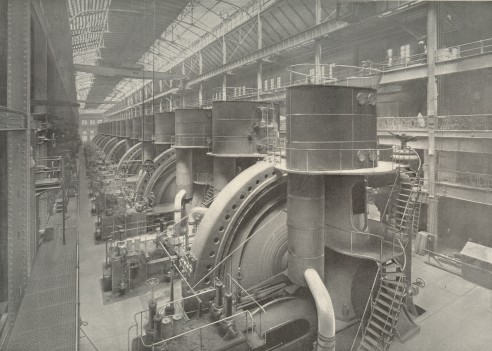
If you were wondering how all of these subways were powered in the late 19th century and early 20th century I have the answer. The IRT built a very large warehouse-looking building called the "Power House". This building was capable of producing over 100,000 horsepower when it was being operated at a normal rate. At the time, this building was capable of producing way more power than any other electrical plant ever built. The "Power House" really did live up to its name because it powered the New York Subways up until the 1960s.

The New York Subway was not only an extremely amazing engineering accomplishment, it is still today the most popular way of getting around New York. There is an incredible amount of people that use this beautiful accomplishment every day and do not even realize that the tunnels that they are speeding through have been there for a little over one hundred years. It is amazing to think what the engineers of the time were able to accomplish with such little technology compared to what we have today.

Pictures found here

(tunnels in process of being built)

(map of Manhattan routs)

(map of routs)

(map of how deep they dug)

(Map of routs)

(Map of routs taken)

(Power House engines)

Thursday, November 3, 2011

"Research Project"

For this project i have decided to research the New York subway system. I am researching how and why they decided to build this. From what i have gathered they wanted to go underground with the trains because it took up much less valuable real estate from the fast growing city of New York.